
Most patients do not need teeth pulled for braces. In my practice, teeth come out in about 30% of cases, and the decision is based on the health of the teeth and the bone around them. When there isn't enough healthy room to line the teeth up, removing premolars is usually how we make it.
I'll be honest: I hate taking teeth out. But when teeth need to come out, they need to come out, and I'd rather tell you that on day one than six months into treatment. Here's how the decision gets made.
On this page
- Why do some people need teeth pulled for braces?
- Which teeth are usually removed?
- What are the alternatives to extractions?
- How does an orthodontist decide?
- Who does the extraction, and when?
- What does recovery feel like?
- Does it make treatment longer or cost more?
- Do kids, teens and adults need extractions?
- What are the common myths about extractions for braces?
- Frequently asked questions
Free consultation, no referral needed, $300 down. Or call (813) 427-2237.
Why do some people need teeth pulled for braces?
Some people need teeth pulled because braces move teeth, but they don't create room. When the teeth are too big for the space the jaw and bone can safely hold, taking out a tooth or two lets the rest line up in healthy bone. Most patients don't need it.
The most common reasons I recommend extractions:
- Severe crowding. There just isn't enough space for every tooth to sit straight.
- Teeth that stick forward. Front teeth that flare out need room to move back.
- A bite that needs space to correct. Some bite problems need extra room to correct properly.
The common thread is space. If I push crowded teeth outward with no healthy bone to move them into, they may look straight for a while, but the result isn't stable and it's hard on the gums and bone. My goal is a bite that stays put and teeth that stay healthy for decades.
Which teeth are usually removed?
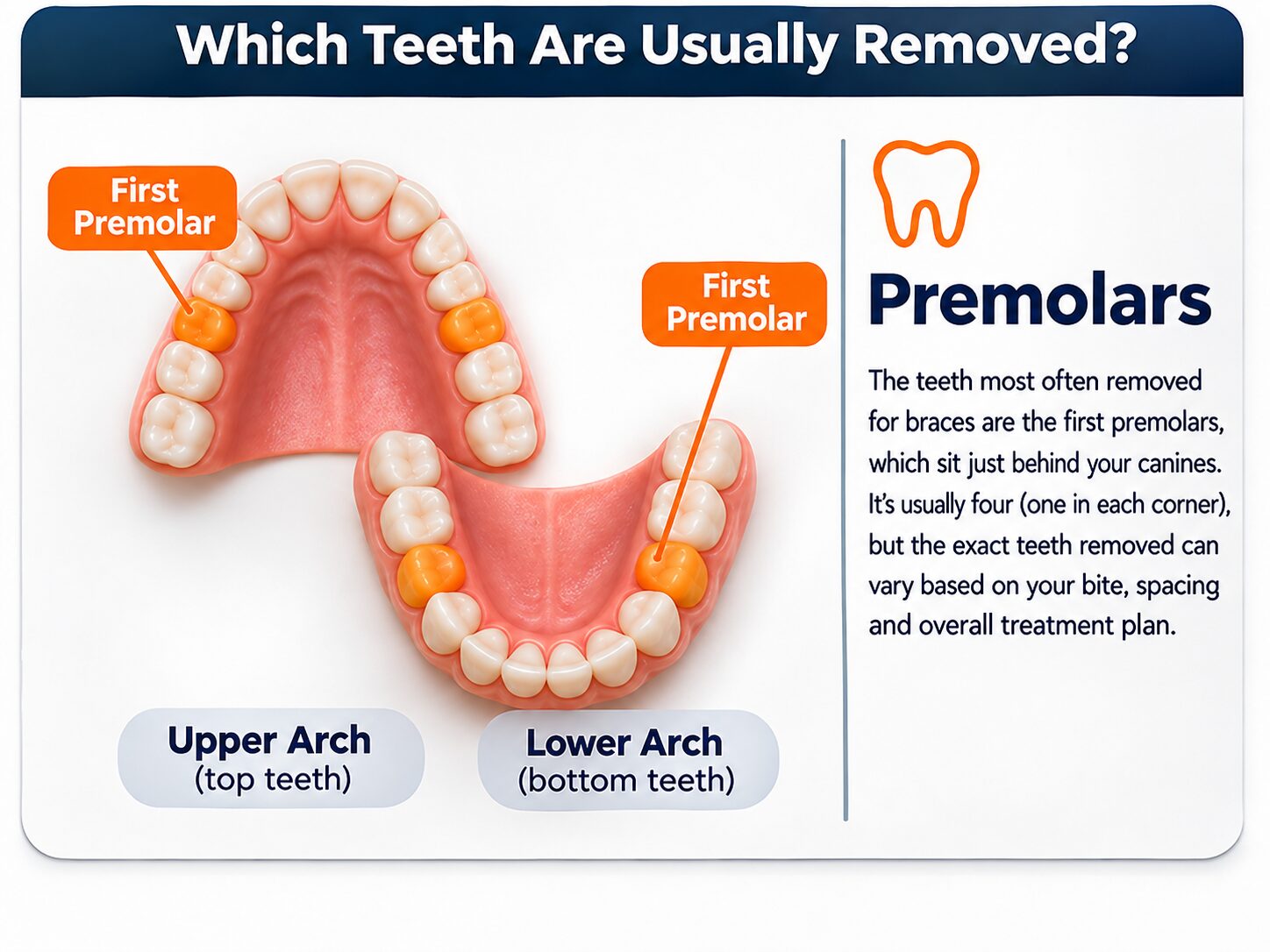
The teeth most often removed for braces are premolars, the teeth between your canines and your back molars. Often it's four, one in each corner of the mouth, but sometimes it's fewer. Wisdom teeth are a separate question.
Why premolars
Premolars sit away from the front of your smile, so removing them has the least effect on how you look. Their spot in the arch also makes them a practical choice for creating room where crowding usually happens. Once the spaces close, most people can't tell anything was ever removed.
What about wisdom teeth?
Wisdom teeth are a different topic. They come in much later, at the very back of the mouth, and they aren't usually what we remove to make room for braces. Whether they should come out is a separate decision made with X-rays, by you, your dentist and me together. See the FAQ below.
What are the alternatives to extractions?
The main alternatives are expanding the arch, polishing a small amount between teeth, moving back teeth, clear aligners in suitable cases, and early treatment while a child is still growing. Which one fits depends on your exam and how much healthy bone you have. No option is right for everyone.
- Expanding the arch. More common in growing children, whose jaws can still be guided.
- Polishing between teeth. A small, careful reshaping of the sides of some teeth, often called IPR, to gain a little room.
- Moving back teeth. Creating space by shifting the molars back, when there's room to do it.
- Clear aligners. For suitable cases, with the same space rules as braces.
- A phased plan. Early treatment in a younger child can sometimes reduce the need for extractions later.
I always look at these first. But I won't pick one just because it's the easier conversation. If the bone isn't there to support it, it isn't a real alternative.
How does an orthodontist decide?
An orthodontist decides after an exam, photos and X-rays that show how crowded the teeth are, how they meet and how healthy the bone around each tooth is. At our office, the decision is made with you and written into the treatment plan at your free consultation.
Why the 3D scan matters
We use a CBCT scanner, a 3D X-ray, at our Tampa office. Older 2D X-rays flatten everything into one picture. The 3D scan lets me see the bone around each individual tooth. That tells me how much room the teeth actually have to move, and whether moving them that way will be healthy for the gums and bone in the long run.
With that information, I can build a plan aimed at two things: a result that stays stable and healthy periodontal tissue, the gums and bone that hold your teeth in place.
Why I tell you up front
Some treatment plans start without extractions and bring the question back up months later. I understand the reason. Nobody enjoys telling a family they need teeth out at the first visit. But I think delaying that conversation six or eight months into treatment isn't fair to you.
So I don't beat around the bush. I only recommend treatment I believe in. If you need extractions, you'll hear it at your first visit, along with why, what I saw on the scan and what the alternatives would mean for you.
Who does the extraction, and when?
Extractions are typically done by your general dentist or an oral surgeon, not in the orthodontist's chair. We coordinate the timing with them so it fits your braces plan. At our office, your braces go on first, and the teeth are taken out after. See the step-by-step order.
Here's how it usually goes:
- Consultation and plan. I examine you, review the scan and write the extractions into your treatment plan.
- Braces placed. Your braces go on first.
- Extraction appointment. After your braces are on, your dentist or oral surgeon removes the teeth. We coordinate with their office.
- Spaces close. Over the following months, the braces gently close the spaces as the other teeth line up.
No referral is needed to see us first, at any of our offices, including Tampa and Brandon.
What does recovery feel like?
Most people are sore for a few days after an extraction. You're numbed during the removal itself. Soft foods, over-the-counter pain relief and the instructions from your dentist or oral surgeon get you through it.
Your dentist or oral surgeon's instructions come first for the extraction site. For the braces side, Advil or Tylenol, taken as the label directs, helps with soreness, and you can always call us at (813) 427-2237. Our posts on whether braces hurt and what to eat with braces cover the first week in more detail.
Does it make treatment longer or cost more?
Extractions can add some time, because the spaces have to close as the teeth move. The extraction itself is billed by the dentist or oral surgeon who does it. Our orthodontic fee is quoted in writing at your free consultation.
For the timeline, our post on how long braces take covers it in detail. Most of our patients are in treatment 12 to 24 months.
On cost, most patients at Miller Orthodontics invest between $3,000 and $7,200, depending on how long treatment takes and how complex the case is. Treatment starts at $300 down with 0% interest in-house financing. See fees and financing for payment options.
Do kids, teens and adults need extractions?
Anyone can need extractions, but the decision looks a little different at each age. In kids, early evaluation can sometimes avoid it. Teens are the most common age for the decision. In adults, the bone has stopped growing, so the plan may differ.
Kids. A first orthodontic check by age 7 lets me spot crowding early. While a child is growing, an expander or a short early phase can sometimes make room. Most children don't need early treatment, and if it's too soon we simply watch. More on braces for kids.
Teens. Most permanent teeth are in, so this is when the space question usually gets answered. See braces for teens.
Adults. About half our patients are adults. With no growth left to work with, the bone health around each tooth matters even more, which is where the 3D scan really helps. See braces for adults or our braces overview.
What are the common myths about extractions for braces?
The most common myths are that braces damage the remaining teeth, that extractions weaken your bite, that everyone with crowding needs them, and that you'll have gaps for years. None of those is how a well-planned case works.
- "Braces ruin the teeth that remain." The goal of the plan is healthy teeth in healthy bone. That's the whole reason for the decision.
- "Extractions mean a weaker bite." The plan is built so the remaining teeth meet properly when treatment is done.
- "Everyone with crowding needs teeth out." No. Many crowded cases are treated without extractions. It depends on the teeth and bone.
- "You'll have gaps for years." The braces close the spaces during treatment.
Frequently asked questions
Do braces require tooth extractions?
Usually not. In my practice, teeth are removed in about 30% of cases. Extractions are only needed when there isn't enough healthy room to line the teeth up, such as severe crowding or teeth that stick forward. The decision is made after an exam and X-rays, including a 3D scan at our Tampa office, and alternatives are always considered first. If you need extractions, I'll tell you at your first visit, not months into treatment.
Which teeth are pulled for braces?
Most often premolars, the teeth between the canines and the back molars. Often four are removed, one in each corner of the mouth, but sometimes fewer. Premolars are chosen because they're away from the front of the smile, so removing them has the least effect on appearance. Wisdom teeth are a separate decision. Once the spaces close during treatment, most people can't tell anything was removed.
Can you get braces without having teeth pulled?
Often, yes. Most of our patients are treated without extractions. Depending on the exam, options include expanding the arch in a growing child, polishing a small amount between teeth (IPR), moving back teeth, or clear aligners for suitable cases. The right choice depends on your teeth and the bone around them, which is what the exam and scan show. I'll walk you through the options that fit your case and the ones that don't, and why.
Who does premolar extractions for braces patients in Tampa?
Typically your general dentist or an oral surgeon. Miller Orthodontics coordinates the timing with them and builds it into your treatment plan. You don't need a referral to see us first. We see patients at all three of our offices, in Tampa, Brandon and Apollo Beach. Start with a free consultation and exam. If you don't have a dentist or oral surgeon yet, ask us at your visit and we'll talk through next steps.
Are teeth pulled before or after braces?
After. At Miller Orthodontics, your braces go on first, and the teeth are taken out after that. I sequence the braces and the extractions in your written treatment plan and coordinate with your dentist or oral surgeon, so you know the order of appointments before anything starts. If you'd like to start the same day as your consultation, mention it when you book and we'll plan around it. See the step-by-step order.
Do braces take longer if I have teeth pulled?
They can, because the spaces have to close as the other teeth move into place. Most patients at Miller Orthodontics are in treatment 12 to 24 months overall, and I'll give you your own estimated timeline at your consultation. Wearing elastics as directed and keeping your appointments are the best ways to stay on schedule. Read more in our post on how long braces take.
Does getting teeth pulled for braces hurt?
You're numbed during the removal, so you shouldn't feel the extraction itself. Expect soreness for a few days afterward, usually feeling a little better each day. Stick with soft foods, and use over-the-counter pain relievers like Advil or Tylenol as the label directs. Your dentist or oral surgeon's instructions come first, and you can always call us at (813) 427-2237. Most people are back to their normal routine within a few days.
Do I need extractions for Invisalign?
Some aligner patients do. The same space rules apply to clear aligners as to braces: if there isn't enough healthy room, the teeth can't line up in a stable way. The exam and 3D scan decide, not the appliance you prefer. At Miller Orthodontics, Invisalign costs the same as braces, so the choice is about your case and your habits. Aligners only work if they're worn 20 to 22 hours a day.
Do I have to have my wisdom teeth out before braces?
Not always. Wisdom teeth are evaluated separately with X-rays, and they aren't usually the teeth removed to make room for braces. Your dentist and I look at them together and decide whether, and when, they need to come out. If they do, that's planned around your orthodontic treatment, so it doesn't slow anything down.
Not sure if you need extractions? Get a straight answer at a free consultation
I'll show you what I see on your scan, tell you plainly whether teeth need to come out and explain why. You'll leave with a written plan and your exact cost. Book your free consultation or call (813) 427-2237. More answers are on our FAQ page.
Free consultation, no referral needed, $300 down.
Miller Orthodontics · Tampa, Brandon and Apollo Beach · (813) 427-2237 · info@northtampabraces.com